

Poetry Guide: Curtal sonnet
The curtal sonnet is a form invented by Gerard Manley Hopkins, and used in three of his poems.
It is an eleven-line (or, more accurately, ten-and-a-half-line) sonnet, but rather than the first eleven lines of a standard sonnet it consists of precisely � of the structure of a Petrarchan sonnet shrunk proportionally, so that the octave of a sonnet becomes a sestet and the sestet a quatrain plus an additional "tail piece." That is, the first eight lines of a sonnet are translated into the first six lines of a curtal sonnet and the last six lines of a sonnet are translated into the last four and a half lines of a curtal sonnet. Hopkins describes the last line as half a line, though in fact it can be shorter than half of one of Hopkins's standard sprung rhythm lines. Hopkins describes the relationship between the Petrarchan and curtal sonnets mathematically; if the Petrarchan sonnet can be described by the equation 8+6=14 then, he says, the curtal sonnet would be:
-
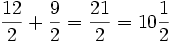 .
.
Hopkins's only examples of the form are "Pied Beauty," "Peace," and "Ash Boughs." "Pied Beauty" is as follows, showing the proportional relation to the Petrarchan sonnet (not included in the original: the only indication of the form is in the preface). Accents indicate stressed syllables:
|  |
|  |
Hopkins's account of the form comes from the preface to his Poems (1876-89). Critics are generally in agreement that the curtal sonnet does not so much constitute a new form as an interpretation of sonnet form as Hopkins believed it to be; as Elisabeth Schneider argues, the curtal sonnet reveals Hopkins's intense interest in the mathematical proportions of all sonnets. For an in-depth treatment of all three poems, see Lois Pitchford. The form has been used occasionally since, but primarily as a novelty, in contrast to Hopkins's quite serious use.
References
- Hopkins, Gerard Manley. The Poems of Gerard Manley Hopkins, 4th edition. Ed. W.H. Gardner and N.H. Mackenzie. Oxford UP, 1967.
- Pitchford, Lois W. "The Curtal Sonnets of Gerard Manley Hopkins." Modern Language Notes, Vol. 67, No. 3. (Mar., 1952), pp. 165-169.
- Schneider, Elisabeth W. "The Wreck of the Deutschland: A New Reading." PMLA, Vol. 81, No. 1. (Mar., 1966), pp. 110-122.
Poetry Kaleidoscope: Guide to Poetry made by MultiMedia Free content and software
This guide is licensed under the GNU Free Documentation License. It uses material from Wikipedia.